Crédits
Interdisciplinary Seminar on Women's Studies at the University of León
aiblag@unileon.es
Digital ISSN: 2444-0221
DOI: 10.18002/cg
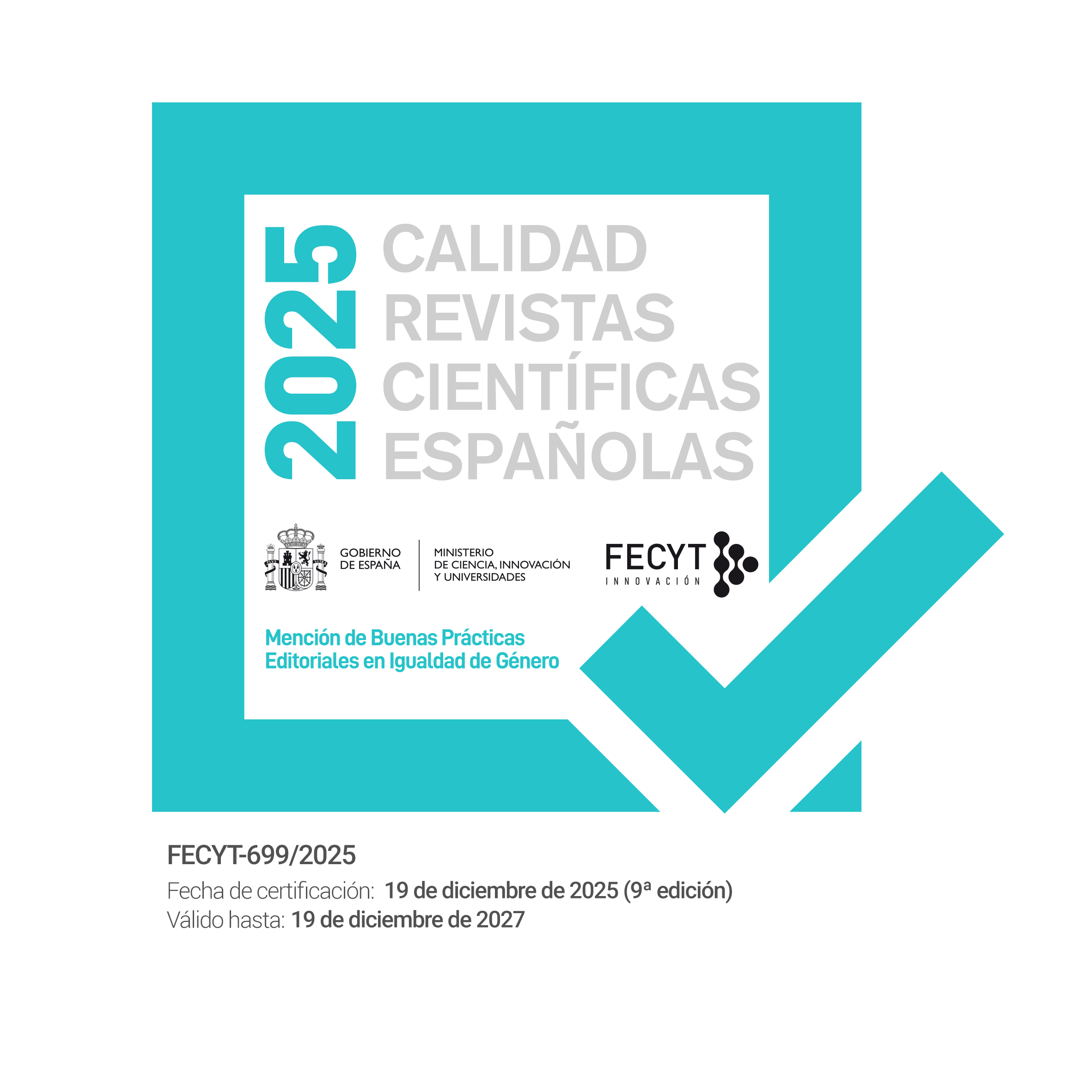
Cuestiones de Género is committed to ensuring wide and accessible dissemination of its published content, following the quality and visibility guidelines required by the Spanish Foundation for Science and Technology (FECYT). To this end, the following dissemination strategies and principles are established:
To this end, the following dissemination strategies and principles are established:
In order to facilitate hypertext and automated content processing, Cuestiones de Género publishes its articles online in HTML and PDF formats. These formats are made available to readers, without restrictions, immediately after online publication.
Each article published in Cuestiones de Género includes a visible "How to Cite" section, with the full reference to facilitate its correct use in academic works. The use of other styles is also encouraged through automated export tools.
Cuestiones de Género allows the automatic export of citations and bibliographic references to search engines such as Zotero, Mendeley, or EndNote through formats such as BibTeX and RIS.
Cuestiones de Género actively promotes its publications through academic networks such as Academia.edu and Google Scholar, as well as on social networks such as como Facebook, Instagram, Linkedin and the Journal Blog, with the aim of maximizing the impact of published research.
As clearly stated in the Interoperability Protocols, the journal uses protocols such as OAI-PMH, which allows for the automated collection of its content by national and international institutional repositories, databases, and scientific aggregators. In addition, the Journal has several active metadata modules such as the Dublin Core 1.1 Module, the Open URL 1.0 Metadata Module, and the MODS Metadata Module, which provide templates that facilitate application compatibility. Additionally, other modules that allow the import and export of metadata are also active, such as the dataCite, mEDRA, CrossRef XML, and DOAJ export/registration modules.
Cuestiones de Género guarantees the long-term preservation of all published content through a combination of technical strategies and institutional support, as reflected in our Digital Preservation Policy. The measures adopted include:
- Storage on institutional servers at the University of León, with periodic backup policies.
- Inclusion of content in national institutional repositories and open access scientific databases such as BULERIA (Institutional Repository of the University of León) or Dialnet, and international ones such as DOAJ (Directory of Open Access Journals).
- Use of the Open Journal Systems (OJS) editorial management system, which allows the structured export of articles and their metadata.
- Application of interoperable standards (OAI-PMH, DOI, Creative Commons licenses) that ensure preservation and reuse in other environments.
These measures aim to guarantee permanent and unaltered access to the journal's scientific content, in line with the principles of open science and editorial responsibility.
Likewise, Cuestiones de Género uses other policies and tools aimed at ensuring its visibility, interoperability, and long-term preservation.
All articles published in Cuestiones de Género are available openly, without economic or technological restrictions, on the journal's official website. This policy reflects the commitment to the democratization of knowledge and compliance with national and international open science regulations.
The content of Cuestiones de Género is disseminated through inclusion in institutional and thematic open access repositories, such as Buleria, Dialnet, REDIB, DOAJ, among others. Likewise, indexing in scientific databases is encouraged to promote the internationalization of the journal and accessibility to the academic community.
Each published article has a DOI (Digital Object Identifier), ensuring its permanent location and citability. In addition, international metadata standards (Dublin Core, OAI-PMH, RFC1807, MARC, and MARC21) are applied to facilitate interoperability with other scientific information systems.
Authors are encouraged to use personal identifiers such as ORCID to improve the traceability of their publications.
Crédits
Interdisciplinary Seminar on Women's Studies at the University of León
aiblag@unileon.es
Digital ISSN: 2444-0221
DOI: 10.18002/cg